Distracted

A typical meditation session looks something like the following.
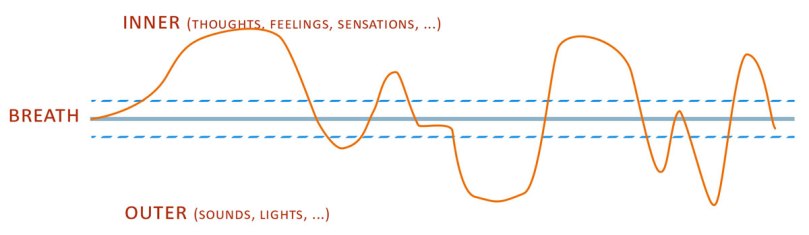
fabrizio-trotti-blog-meditation

You set out to meditate, and you begin by putting your attention on your focus (breath in my case, for some it’s a mantra, or the body, or something else).

Very soon, a distraction appears. This might be something coming from within you, for example a thought (“I’ll do this after I am done”, “Why did I say something so stupid?”, “What am I going to do about that?”), a feeling (tiredness, sadness, anger, disappointment, hunger, thirst), a sensation (“My back hurts”, “My foot is sore”, “The cat is on my lap”, “The sun is warm today”). Or something that comes from the outside world, for example your phone ringing, somebody suddenly switching the light on, your kids shouting your name as the episode of their favorite cartoon series has ended and the new one does not start automatically.

Some distractions are stronger, some are weaker. Some are longer, some are shorter. Eventually, what you are supposed to do is to gently acknowledge the distraction, letting it go, and go back to the source of attention, your focus.

If you think about it, this is something that happens everytime we set out to do anything. Even if we are very careful managing our attention (for example by sitting without our phone in view, or by chosing to work from a library), distractions will happen. All the time. The quality of what you do and the amount of time you spend doing it depends on how good you will become at acknowledging the distraction, letting it go and going back. And meditation is an excellent exercise.

In meditation and in our daily lives there are three qualities that we can nurture, cultivate, and bring out. We already possess these, but they can be ripened: precision, gentleness, and the ability to let go.

Pema Chödrön

I’ll do it later

There are three pitfalls of “I’ll do it later”.

The first one in that “later” rarely comes. When we are in the present and we say “I’ll do it later”, we expect a future moment in which we will not only recall that we have that thing to do, but we will also be sufficiently free, awake, willing, energetic to actually do it. As our lives go by, we very rarely get to those moments, various different things getting in the way.

The second one is that as we postpone things, we end up increasing the clutter. Mental and material clutter alike. Keeping things in mind drains energy, and we can only remember a limited amount of things at any given moment. We then use to-do lists, productivity apps, calendars, email inboxes, reminders. And when we defer an item, we end up making it more and more difficult to see and act upon it. It’s what happens when your inbox unread list grows above ten emails.

The third one is that the thing we were supposed to “do later” will certainly pop up in a moment when we can’t do anything about it. Say, when we are already in bed, or while we are driving to work, or when we have just started playing with our kids. And we will feel a little more miserable, and probably end up doubling down on the “I’ll do it later”, resetting to number one of this list.

It turns out, many of the things we push to “later” can actually be done now, without to much of a distraction or effort. And if there are too many of those, than it is probably time to rethink priorities and what is important. Keeping many balls in the air will eventually make you drop all of them.

This is Marketing

What I wrote yesterday about the commoditization of marketing is deeply inspired by the work of Seth Godin.

This year, I have read his most recent book, This is Marketing, and despite having followed his blog for years now, and being familiar with most of his ideas, I felt it was the missing piece in my approach to marketing. A way to translate things that are already profoundly rooted in my practice into easy and plain words that everybody can understand.

You can’t be seen until you learn to see is the subtitle of the book, and that is a common thread througout the pages. The focus on empathy and on the necessity to deeply understand who you are serving is one of Seth’s mantras. There’s a metaphor he uses this time around, that is not only great at describing this approach, but also in differentiating it from the other side of marketing, the commoditized side.

It doesn’t make any sense to make a key and then run around looking for a lock to open. The only productive solution is to find a lock and then fashion a key.

Seth Godin

Marketing is about building a relationship, this should be nothing new to anyone who has read Kotler and his principles. And despite this being one of the oldest precepts of the field, we keep forgetting it, because other ways are more alluring and promise shorcuts to achieve results.

For Seth, it all starts by understanding what is the change you seek to make. Because every marketer is in the business of “making change happen” (and everyone who wants to make a change is a marketer). Then, understanding that changing everyone, seeking the mass, is not only unrealistic, it also sets us for mediocrity and disappointment. The only real possibility is identifying our “smallest viable audience“, the smallest market we (or our company) can survive on. And do our best work and responsibly bringing it to them.

This is Marketing is about a way to do marketing that considers affiliation more important than dominion.

Modern society, urban society, the society of the internet, the arts, and innovation are all built primarily on affiliation, not dominion. This type of status is not “I’m better.” It’s “I’m connected. I’m family.” And in an economy based on connection, not manufacturing, being a trusted member of the family is priceless.

Seth Godin

Affiliation, though, does not happen when you talk about how perfect your features are, or when you bombard people with flashy and catchy ads. It is a slow and long process, one that requires patience and consistency, and one that cannot be measured. And that’s where most marketers fail nowadays: they use the prime tool for affiliation (content marketing) and pretend to dress it for dominion (us, us, US!).

Eventually, if the marketer is successful, they will have served people that will spread the word (“the best reason someone talks about you is because they’re actually talking about themselves”, about their taste, about what is important to them) and that will speak up if they are missing (permission marketing).

This is Marketing is a beautiful read about mindset and change, one that is not for marketers only. Actually, it is for marketers only, but we all are marketers nowadays.

For a long time, during the days when marketing and advertising were the same thing, marketing was reserved for vice presidents with a budget. And now it’s for you.

Seth Godin


Protect who you are

Whether we are on the giving or on the receiving part of feedback, we need to make it very clear that there is a distinction between what we do and who we are.

This is liberating. Understanding that what the other person is saying is not a personal critique, as well as approaching the act of providing feedback with the intent of not imposing our worldview on the other, is what makes a relationship stronger and thriving.

So, when we ask for feedback, let’s be specific in what we are seeking. Can you tell me what you think of this thing I wrote? Do you think I should use this or that framework? What would you do to make it better? How do you think I could get better at presenting?

And let it be clear (to us) that what is at stake is not our character, our career, our relationships, our life, our future, our being. Only a minuscule part of that.

When we prepare to give feedback, on the other hand, let’s focus on things that happened and on how we interpreted that or how it made us feel. When that happened, I noticed everyone in the room went silent. This other framework is used more in such cases, because… . I really liked that part of your last e-mail, I find it showed great empathy and consideration. Your presentation featured very interesting information for the company, and with this and that you can make it memorable next time.

If we set a middle ground to have the conversation, without aggressing the other person’s space and building a resistance to our more vulnerable self with awareness and confidence, the magic of candor can truly happen.

Inputs and outputs

Admitting that luck has a huge part in most of our achievements and successes does not mean diminishing them. Nor does it mean diminishing our skills and capacities.

It’s more about understanding that there are a set of things we have under our control and a set of things (usually bigger) that we have absolutely no power over. When we understand this fundamental difference, than it is a whole lot easier to practice accordingly and let go of worries, preoccupations and anxieties that are linked to the latter group. And usually strongly limit and hinder our performance in the former one.

You can decide to show up for work every day, you cannot control the path your career will take five or ten years down the road.

You have power over how you will use your time today, you have none over whether people will like what you did or will agree with your decision.

You can set out to begin a project that can potentially touch the life of many people, you cannot decide whether people will actually be touched by it, or change their mind if they are not.

It is up to you to say yes or no to that request, you have very limited grasp on what will happen next.

When we look back at the successes we’ve had, we should praise the role of the work we’ve done, of the efforts we’ve put in, and also be very mindful of the fact that under very similar circumstances the outcome could have been completely different. You can call it luck, randomness, environment, chance, context. It does not matter. As scary as it sounds, you control the inputs, never the outputs.