Care

“Press 1 for contracts, invoices, and any other issue” is not a very useful step in the journey of your customer.

“I am experiencing a small technical issue, let me fix that, and I will call you back in five minutes” is a great step in the journey of your customer.

It sounds silly to still be talking about this in 2023, yet so many company fail at the “care” part in customer care.

Blaming people

It’s easy to blame it on people.

They’re not fast enough.

They’re not good enough.

They can’t sell.

They don’t know what they are doing.

They are a wrong fit.

They don’t know how to take criticism.

But when that happens all the time, it’s likely that the problem is in the system.

Do you onboard people well enough?

Do they know what is expected of them?

Do you talk to them and listen?

Do you give them space and freedom to operate?

Do you say when things are not working?

That’s much more difficult to fix. And if you don’t do that, you’ll keep blaming it on people.

What does that mean

If you are looking for a way to align across teams, start with definitions. Particularly, definition of metrics and KPIs.

A meeting is a meeting, right? Think again.

A signup is a signup, right? Think again.

A sequence enrolment is a sequence enrolment, right? Think again.

Going through what things mean, exactly, can be a painful, unnerving, boring process. And nobody ever wants to actually ask the question.

But when it’s done and documented, there’s immediate alignment and clarity.

Choose carefully

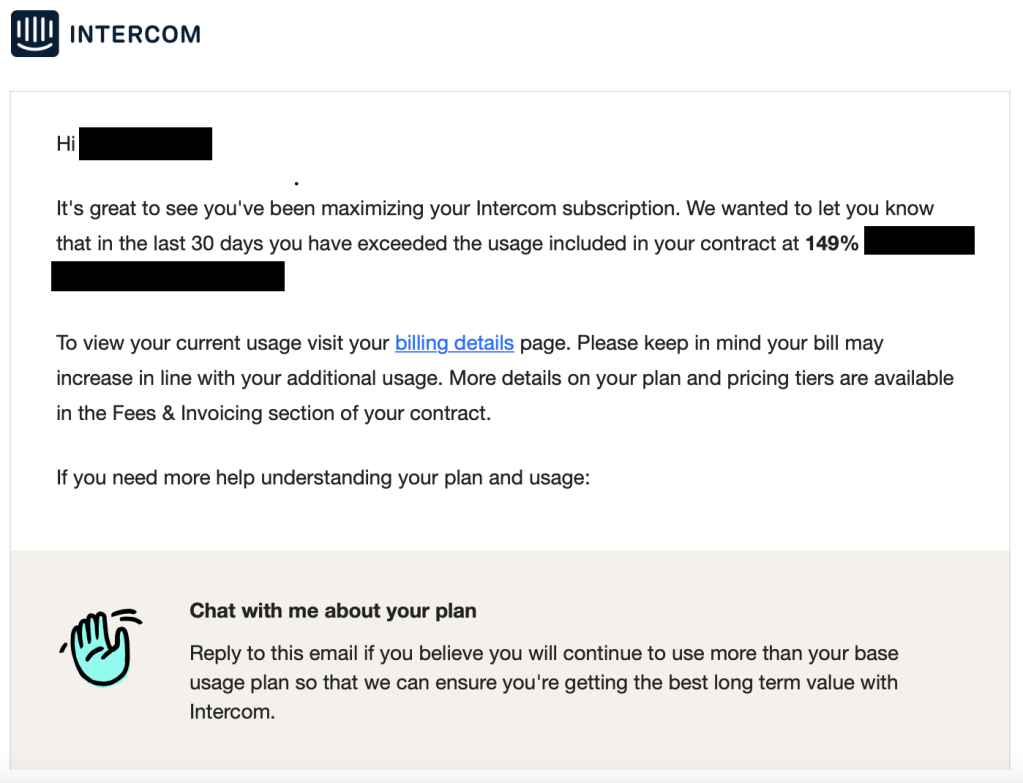
Hubspot and Intercom are very successful companies. And on the exact same type of communication to their customer, they choose two completely different approaches.

One is before, the other is after.

One raises awareness, the other raises alarm.

One gives you agency, the other takes it away.

One is about hope (“Your contacts database is growing”), the other is about failure (“You’ve exceeded the usage”).

Also (you can’t say that from the message alone, but I’ll ask you to trust me), one is true, the other is not.

There is no right or wrong way to do stuff.

But the choices you make say a lot about who you are and what you stand for.

Talking about it

If you have something you care about – an idea, some work you have done, a job, a project, a new product -, it’s fair for you to assume that nobody else will get it. And it’s your responsibility to explain it, sell it, evangelize it, adjust it, combine it, market it.

That means two things.

First, that we can’t assume that we will hit the mass on day 1. Overnight success is a hoax, but you know that already.

Second, and most importantly for this post, that your role very soon gets much more complex. Because if you want to buy people into whatever you are doing (that you care about), you need to spend a large amount of your time talking about it.

And I guess that the bad news is that nothing is self-evidently great.

And the good one is that everything can be.