Indicators

A change in focus requires a change in indicators.

If you decide to focus on employees well-being and retention, why are you still talking about growth rate?

If you decide to break down the silos, why are you still setting goals and reporting results by department?

If you want to spend more time with your family, why is your salary still the measure of your success?

A change is a change.

Choose carefully

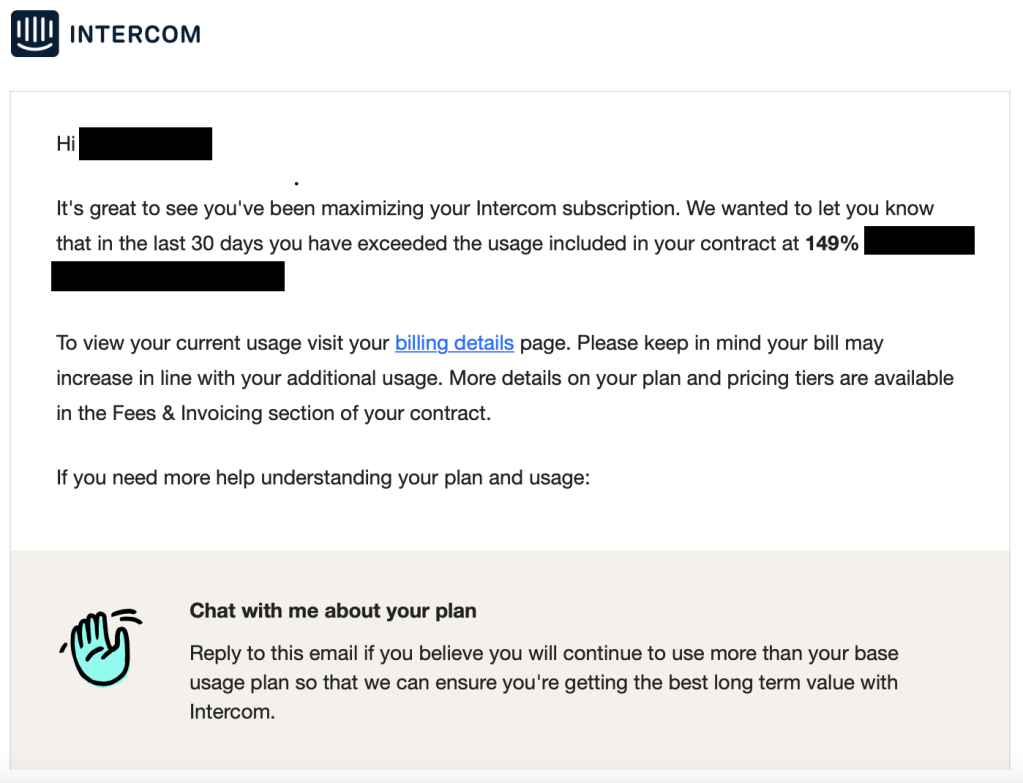
Hubspot and Intercom are very successful companies. And on the exact same type of communication to their customer, they choose two completely different approaches.

One is before, the other is after.

One raises awareness, the other raises alarm.

One gives you agency, the other takes it away.

One is about hope (“Your contacts database is growing”), the other is about failure (“You’ve exceeded the usage”).

Also (you can’t say that from the message alone, but I’ll ask you to trust me), one is true, the other is not.

There is no right or wrong way to do stuff.

But the choices you make say a lot about who you are and what you stand for.

Talking about it

If you have something you care about – an idea, some work you have done, a job, a project, a new product -, it’s fair for you to assume that nobody else will get it. And it’s your responsibility to explain it, sell it, evangelize it, adjust it, combine it, market it.

That means two things.

First, that we can’t assume that we will hit the mass on day 1. Overnight success is a hoax, but you know that already.

Second, and most importantly for this post, that your role very soon gets much more complex. Because if you want to buy people into whatever you are doing (that you care about), you need to spend a large amount of your time talking about it.

And I guess that the bad news is that nothing is self-evidently great.

And the good one is that everything can be.

Back in my days

Back in your days, things were certainly different. But I promise you, any judgement you are giving on 30-40-50 years before in your life is probably inaccurate, biased, and positively or negatively exaggerated.

It’s a good base to make a joke, not a good one to make a decision.

Mental shifts

When I was a teenager, and computers where just starting to become common things in Italian households, I remember a family friend used to be convinced that they could transmit viruses that where dangerous to people.

What happened is that he probably heard about computer viruses, and he just stuck to his own definition: viruses are a danger for human beings.

This challenge in making new ideas fit into old mental concept and ideas is very common. And if you fall into that, you are not an idiot or uneducated. You simply still have not had the mental shift.

And for that, you are pretty much always in time.