Stay on point

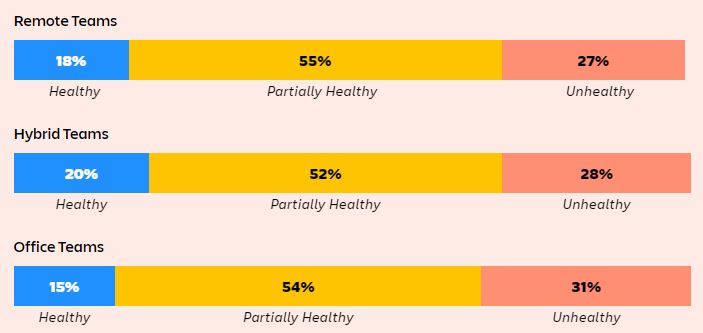
If you are busy trying to understand whether your team should work remotely, in the office, or in an hybrid format, you are most likely busy with wrong kind of questions.

Atlassian, State of Teams report – There is no material difference in a team’s health based on where they work from.

It might be yet another issue that distracts from focusing on the need to reassess what management means and what people seeks in organisations and their work.

Let’s stay on point.

Compensation strategy

Data about average salaries at a company, combined with data about average salaries at similar companies, is a huge and underutilized opportunity for any organization.

And not because one has to match or surpass the others, ensuring that they offer the top rates in the market. Quite the opposite, in fact. It is an opportunity because it gives the company the chance to start a conversation about an important piece of their culture and identity, and about how that compares with the rest of the market.

Money is but one motivator for most people, and not even the most relevant in many cases. Offering lower salaries and more of the rest can be a powerful statement and a winning strategy when done intentionally.

The alternative is what already happens in most cases: money as the main leverage in individual, secretive, transactional negotiations that leave each employee with the conviction that they can leave as soon as somebody will pay them more.

It is wasted potential.

Two myths

There are two myths that new managers often fall for, and that have the potential to create immense damage to their teams and themselves.

Myth #1 – The manager knows everything. Of course, it is false. The easier it is for a manager to say that they do not know, even large chunks of what is considered their responsibility, the more their team will thrive (looking for answers) and the more they will enrich their experience (being exposed to things they had not done in the past). It is a myth that can be dispelled by asking and listening.

Myth #2 – The manager needs to protect the team from everything. Change, challenges, and crisis will be upon your team in no time. It is only by putting them on the front line that they will be able to learn (also to be a manager in the future) and that you will have the time to dedicate to what matters most (supporting them as they are out there). It is a myth that can be dispelled by opening doors and letting people roll.

Appearance and substance

The way you behave with people is at least as important as the words you speak.

The story you tell is at least as important as the subject you are narrating.

The marketing you deliver is at least as important as the product you have come up with.

The point is, there is appearance and there is substance. Pretending one does not exist just because it makes you uncomfortable is heavily limiting your own possibilities to succeed.

Make the effort to align them instead. Make behavior and words, story and subject, marketing and product go hand in hand. Bring one at the same level of the other. Make them support each other and be in harmony.

That’s when the feeling of uneasiness will just go away.

The biggest difference

A difficult step towards awareness is appreciating that we are not so special after all.

The things we think, the emotions we feel, the fears that get us stuck, the ambitions that drive us, the confusion in the face of uncertainty, the defensiveness when we fail. They are common to many and they do not make us any different from all others human beings.

Once we are fine with that, then we can dedicate time to what truly matters: how we react to all that and to an ever-changing world.

That’s where the biggest difference is.