Right in the moment

As an Italian abroad, I am a huge importer of pasta from Italy. When I saw this today, I got hopeful.
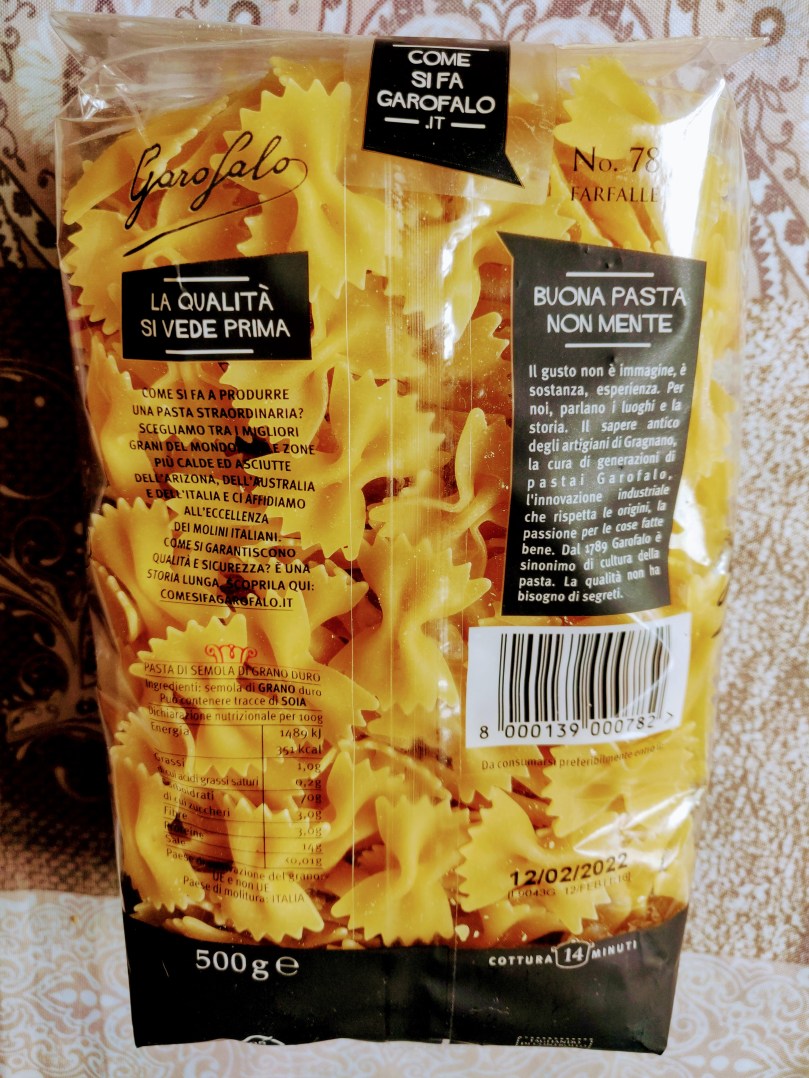
fabrizio-trotti-pasta-garofalo

The packaging is in Italian, but what got my train of thoughts started was the little branded tape that sealed the thing. It reads “comesifagarofalo.it”. A custom site the producer really wants me to check out as I am opening the package! (“come si fa Garofalo” could be translated into “how Garofalo is made”, yet in Italian the verb “to make” could also be used as “to cook”).

I got interested in the label as I have experienced many people do not know how to cook pasta. I have been asked about that quite a lot since I moved out of Italy, and I have some horror stories about how people actually go about cooking pasta that I will leave for a stormy night in the forest.

I hoped the company did recognize the problem and decided to put up a mini-site to educate people about this. I imagined a very simple site with the 3-4 key instructions (it is really that simple) right on top, perhaps a video, some hilarious “don’ts”, and a bunch of recipes. A company who made its name because of the quality of its pasta (Garofalo definitely has) should also care about how that is cooked and consumed. The possibility got me really excited.

That did not last long, as I unfortuntely found the mini-site was a mere way to showcase the manufacturing process of Garofalo pasta (where the ingredients come from, what is the process that goes into it, and so on).

I find this a missed opportunity to build a meaningful relationship with customers. When people have a package of pasta in their hands, the water boiling in the pot, I doubt they might be interested in where that pasta comes from or whether the ingredients used are genuine. I don’t mean to imply these are not important things in the buying process of a package of pasta (to some people, at least, they are). Yet by the time you have read the information on the website, your guests might have arrived, your water will have evaporated, and pasta will not be served for another half an hour.

When you think about how to promote your brand and its quality, always keep in mind that the customer has different types of interactions with the product. And while consistency is important, that does not mean you have to feed information about manufacturing and quality when they are about to cook their dinner. Think about what their needs might be at every stage, and give them what they might need the most in that moment. It is that simple, and yet definitely not easy.

Positioning

What does a book from the 80s have to teach to marketers today?

Let’s see.

Advertising is, for the most part, unwanted and unliked. In some cases, advertising is thoroughly detested.

[…]

In general, the mind accepts only that which matches prior knowledge or experience. Millions of dollars have been wasted trying to change minds with advertising. Once a mind is made up, it’s almost impossible to change it. Certainly not with a weak force like advertising.

[…]

as the effectiveness of advertising goes down, the use of it goes up. Not just in volume, but in the number of users.

These are some of the aspects Ries and Trout start from in their book, Positioning: how to be seen and heard in the overcrowded marketplace. And they bear quite incredible similarities to the environment marketers operate in nowadays. Almost 40 years after the book was written.

The solution to this mix of sensory overload and advertising inefficacy is positioning, the process that leads (better, should lead) companies to identify a space in the prospect’s mind and leverage it for growth and success. Contrary to common shared belief, indeed, growth and success are not in the product and its features, they are in how the audience and particularly your prospects remember and talk about you.

Not surprisingly, Ries and Trout share quite many examples of companies who did positioning right and companies who did it wrong (back in the Seventies and Eighties), and perhaps the more interesting examples are the ones the authors dedicate a full chapter each in the second half of the book. Some commonalities.

  • Find a space (“cherchez le creneau”, as they say in French) that is not taken, no matter if it is a small one, and be the first to move there.
  • To find that space, the company needs to know a whole lot of things that have very little to do with the product or service they offer: market, competitors, audience, prospects, and so on.
  • Be mindful of the importance of the name of your product or service, better if it is a name that reminds what the product or service stands for.
  • Avoid name extensions to the best of your abilities (“When a really new product comes along, it’s almost always a mistake to hang a well-known name on it“).
  • Be consistent with your positioning strategy in the long-term, particularly in times of change, when it is more beneficial to change tactics rather than strategy.

Positioning is one of those books that anybody who starts a career in marketing should read and keep close throughout their careers. It really is too easy to forget about the importance of everything that is not the product/service you are offering (competitors, environment, audience, etc.) and fall in love with words and messages that mean literally nothing to the people you seek to serve.

This is the classic mistake made by the leader. The illusion that the power of the product is derived from the power of the organization. It’s just the reverse. The power of the organization is derived from the power of the product, the position that the product owns in the prospect’s mind.


Metrics that distract

Reading this reminded me of the time I found a job ad for Social Media Manager listing 1,000 (or was it 10,000) friends on Facebook as a requisite to apply.

We are easily mislead by what is not important, and so we believe that doing Marketing on social media is about metrics that are as much visibile as they are insignificant. And of course, managers and executives are then disappointed when they come to this very realization.

Continue focusing on bringing consistent value to your audience where they are, and stay clear of distraction-metrics. Long-term success will be your reward.

Deaf to ads

Banner blindness is a concept that dates back to 1998. It is a phenomenon according to which when scrolling a web page, we consciously or unconsciously ignore banner like information.

As consumers (and therefore advertisers) shift towards audio consumption, I have the impression we are also developing a sort of advertising deafness. Similar to banner blindness, advertising deafness means that when we are listening to a podcast, music streaming, or even a video, we tune out the promotional messages, as we perceive them as a disturbance.

Considering the serial nature of podcast in particular, and the fact that the audience tends to listen to them regularly, a nice way to overcome advertising deafness would be to take advantage of the potential of this medium. So, instead of running 30 seconds ads, marketers could try to tell episodic stories about their brand, their product, their service, and the way they are impacting the world.

It is lazy and inefficient to use old formats in new media. If you give people something to wait for, something to even long for, they will listen. And your message will have the power it (perhaps) deserves.

Assume people don’t know

Start by assuming that people don’t know. When you present an idea, when you share a thought, when you introduce your audience to your product or service, imagine how it would be to talk about that to somebody who is absolutely clueless. Chances are, they really are.

Take Ikea instructions, for example.

For as much as people make fun about them, the way Ikea presents how to assemble its own furniture is the clearest and easiest around. Just try another brand and benchmark.

Their minimalist design never fails, provided you can follow it to the letter (well, to the image) without trying to venture away from it. They have no words in it, no complicated code for the different pieces, the drawings are not necessarily captivating or artistic, and yet they never fail to tell you if that little hole goes on the inside or on the outside. And the great thing about them, is that they often are lengthy and elaborated, as they assume the normal person does not have the knowledge or experience for the job.

The next time you are sharing something important, think about Ikea’s instructions. And see how you can be as close to them as possible.