Busyness is laziness

As counter intuitive as it might sound, I find this Buddhist teaching very relevant to the World we live in today.

“I am busy” is a story we all tell ourselves and others, and it is a very convenient way to avoid facing what matters and the reality of everyday. We hide behind a wall of importance and hectic behaviour. And this is particularly serious, I believe, when “I am busy” is no longer a way to describe our current, temporary status, but a way to tell about who we are and how feel.

When you are too busy to honor your highest priorities – which are understanding your life, discovering your wisdom, and offering your heart – that is a sign that you’ve let something slip because of laziness.

Susan Piver, Start Here Now

Next time somebody is asking “how are you?”, avoid the “I am busy” trap and take a moment to reflect on how you actually feel and what is appropriate to share with the other (and how). That might start a very different conversation than the unsympathetic one we got used to. And it might also be a nice way to begin rethinking your priorities and what to dedicate time to from there on.

Learning beats failure

Of all the buzzwords that permeate today’s business environment, “failure” is perhaps one of the most misunderstood.

“If you are not failing, you are not trying hard enough.”
“There is no success without failure.”
“We allow our people to fail, failure is the most beautiful thing that could happen.”

You’ve probably heard one version of those sentences, and while they all make sense, they put the emphasis on the wrong aspect of the process.

One of the things about failure is that it’s asymmetrical with respect to time. When you look back and see failure, you say, “it made me what I am!” But looking forward, you think, “I don’t know what is going to happen and I don’t want to fail.” The difficulty is that when you’re running an experiment, it’s forward looking.

Ed Catmull

Nobody wants to or can start a project thinking about failure. It goes against how our mind thinks, and it would be the end of the project itself.

A different approach is to shift the focus on the learnings. What about starting a project saying “I want to learn how this works”, or “I want to find out if A is better than B”, or “I’d be happy if by the deadline we would know something important that we do not know today”.

Organisations should leave space to reflect on what is happening (both failures and wins), to share the results of the reflection, and to give others the possibility to absorb relevant learnings from what somebody else has done (again, good or bad).

“If you are not learning, you are not trying hard enough.”
“There is no success without learning.”
“We allow our people to learn, learning is the most beautiful thing that could happen.”

Much better.


The theory of empathy

To most people, empathy does not come natural. It certainly does not come natural to me. For many years, I have had the tendency to put myself at the centre of the World. Everything that happened was, to some extent, because of me.

People were certainly acting in a certain way because they wanted to signal something to me. My friend had stopped calling because for sure they did not want to hang out with me any more. My boss was being cranky because she did not like my job and was about to fire me. My girlfriend was being cold because clearly she was not interested in me anymore. And so on.

This slowly built up a worldview according to which it was very difficult for me to be empathic. On one side, the others were mostly being negative. On the other, they were being negative because of me, and so I was also unworthy of their interest, friendship, trust, love.

Raise you hand if this situation sounds familiar.

I had to train myself in empathy. Here is what Wikipedia says about empathy.

Empathy is the capacity to understand or feel what another person is experiencing from within their frame of reference, that is, the capacity to place oneself in another’s position.

Sounds intimidating just by reading it.

The first step I took was to start asking people about their motives. What I found floored me. In 99.9% of the cases, I was not the reason why they were acting in a certain way. I found, actually, that most people had feelings that I was very familiar with, or were living through situations that I had also lived through in the past.

After I started approaching meditation, and to some extent a more Buddhist take on life, one theme resonated with me. We are all going through the same distress. Even though our lives are different, even if some have more and some have less, even if some are alone and some are not, even if some live in some place and some in another. We are all challenged by the attempt to make sense of a World that is senseless.

When you understand that what you feel, what you think, what you live is an experience you have in common with other human beings, that is the moment empathy unlocks.

I am still learning, and it is easy to fall back to certain patterns, easier than one would care to admit. Real empathy is one of the most needed characteristics in today’s World, and what is incredible about it, is that it expands in a sense of belonging like no other I ever experienced before.

Good luck on your path.
Emotions and rationality

If you are using emotional tools to address a rational problem, chances are you are going to struggle in the medium/long-term.

Say you are at a meeting discussing how many new hires you need for the next project. Since you know that hiring people, onboarding and training them is a lot of work, and you’d rather focus on something different, you leverage the fear of taking risks of your boss, throw some numbers in the air to make your point, and end up scoring a point. In the medium term, your team will be understaffed.

This is the same mechanism we are seeing at work with Brexit and most of the populism around the World. A real, concrete, rational problem (i.e. an increasing part of the population is being left behind) is addressed leveraging emotions (fear, anger, hatred). Good results in the short-term (Brexit was voted, many populists are being elected), but when it comes to putting together concrete acts to move past the feelings, not much can be done.

Something similar happens with the opposite. If one of your team members is struggling to share ideas and participate in team meetings (an emotional problem), and you decide that from now on meetings will feature a “let’s go around the table” moment (a rational tool), you will force the team member to speak, yet not necessarily get the best ideas out of them.

Facebook is in the process of understanding this very thing. In trying to cope with the spread of hate speech and inappropriate content on their platform (emotional problem), they have decided to ramp up the number of moderators and feed them 14,000 pages of instructions on what is acceptable and what is not (rational tool). Clearly, it is not working.

Beyond malice and opportunism, make sure you know on which level your problem is, and come up with a solution that speaks the same language. Your chances to make an impact and be trusted (forever?) will increase dramatically.

Bias

It takes mental effort to identify our own bias.

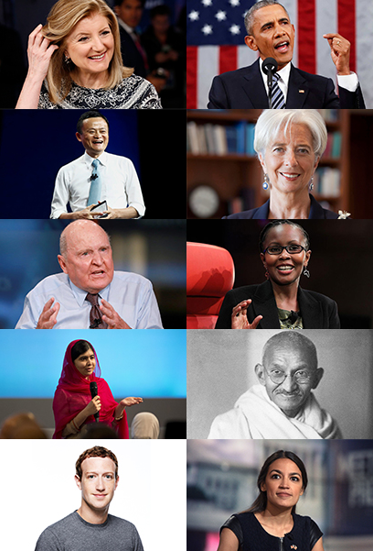
Few months ago, I was putting together a presentation about Coaching and Leadership. I wanted to have one slide to stimulate some discussion, and I wanted to ask people in the audience to describe leadership with one single word.

Along with the question, the slide was supposed to feature a collage of known leaders. To my dismay, I quickly realised I was victim to bias. The first few names that came to mind were (in order) Steve Job, Mark Zuckerberg, Barack Obama and Jack Welch. All male. All American.

I could have certainly stuck with those, and probably nobody would have complained. Yet, as I knew by then I was biased, I forced myself to do a better research (both in my memory and on the Internet), and eventually came up with the following collage.

Leadership-bias

It was great to do that. Not only because I had a far better depiction of what a leader is and might be, but also because I had the chance to identify bias at work. At least, a certain type of bias. Perhaps next time, this list will come more naturally. And perhaps, I will be able to identify similar bias in other situations more easily.

By the way, in case you are wondering who some of the leaders in the collage are, here is the full list (from top left).